
‘Here and Now, Now and Then’
The work in ‘Here and Now, Now and Then’ addresses a number of themes using various media. I have an ongoing interest in consumer culture, mass production, and the concomitant illusion of choice generated by these. I’m drawn to race and gender issues, as well as the impact of the built environment on human consciousness. My experience in architecture influences my worldview and the formal vocabulary I’ve developed.
The work in ‘Here and Now, Now and Then’ is not driven by a single medium. I sometimes use installation-based mixed media; at other times constructed photographs. I move between media depending on which best serves the concept at hand.
Multiples are fundamental to my work, as the repetition of elements is essential in addressing my chosen themes. Multiples produced through the casting process form the basic vocabulary of the three dimensional pieces. I either make my own molds or repurpose commercially produced ones. Other components and media are added as the pieces evolve into their final forms.
Porcelain and beeswax are the primary casting materials in ‘Here and Now, Now and Then’. I became interested in wax as a medium after I began keeping bees about seven years ago, and started working with unglazed porcelain around the same time. Both beeswax and porcelain have a fragile, luminous quality, imparting a delicacy to the cast objects at odds with the banality of the subject matter.
Encaustic constructed photographs make up the 2-D elements of ‘Here and Now, Now and Then’. The subjects of these photographs are arrangements of objects I’ve created through casting or construction.
I’m after a kind of visual poetry in my work, hoping to trigger a string of associations in the viewer the way a good haiku would.
‘Freedom of Choice’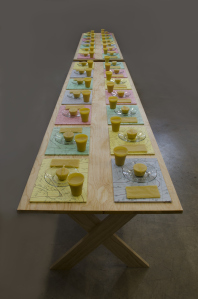
‘Freedom of Choice’ speaks to the illusion of choice characterizing much of contemporary life.
In ‘Freedom of Choice’, abstracted, child-sized wooden picnic tables are neatly lined with placemats. The pastel-tinted placemats, printed with fragments of subdivision layouts, hold nearly identical snacks. Squiggle topped cupcakes, a food icon, are cast in golden beeswax, along with drinks in styrofoam cups and folded paper napkins. Pretty and appealing at first sight, they hint at a numbing reality. This classic snack gives off a faint scent of honey and a translucent glow, and, like the real thing, has no nutritional value.
The tables, arranged in a long line, evoke an institutional setting. Kindergarten cafeterias, military, prison and internment camp mess halls all have much in common. But for scale, the tables in ‘Freedom of Choice’ could serve equally well in any of the above settings.
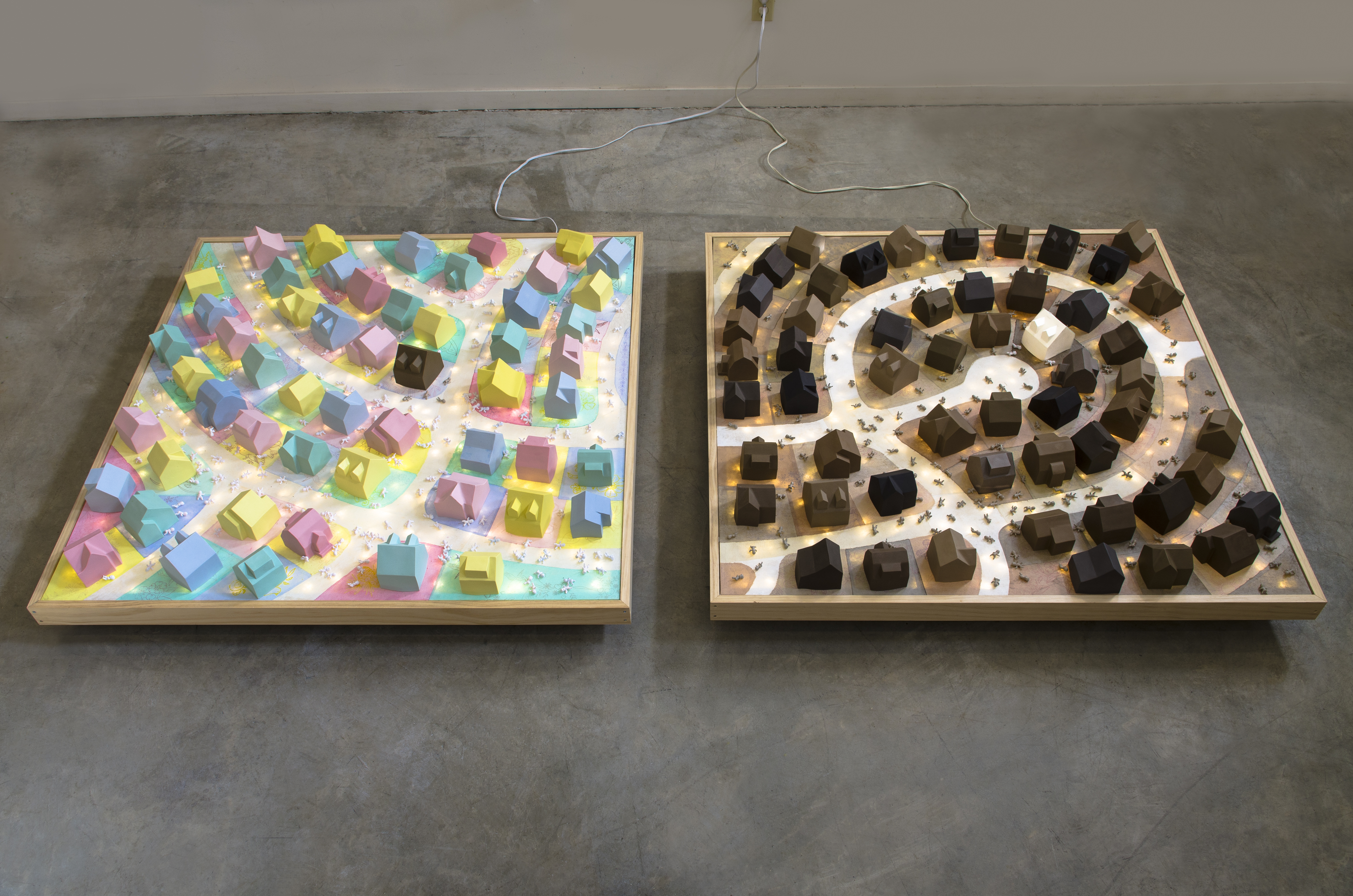 There Goes the Neighborhood 1950-2050’
Segregation in baby-spouting suburban communities was a fact of life in post-war America. ‘There goes the neighborhood’, a familiar phrase invoked when the first dark-skinned family moved into an all-white area, expressed the fear that falling house values, rising crime, and general decline would inevitably follow.
The pastel perfection of the 1950’s neighborhood in ‘There Goes the Neighborhood 1950-2050’ is disrupted by the presence of a chocolate brown house, as well as brown babies around it. Changing demographics and social norms predict a new version of ‘there goes the neighborhood’. Historically, white people moving in to an established neighborhood of color suggested the beginning of a gentrification process. By 2050, could the white family moving in signal the decline of the area, and consequently be cause for alarm? Or will a more tolerant attitude prevail toward the newly minority white population?
The houses in ‘There Goes the Neighborhood 1950-2050’ are made of tinted slip-cast porcelain. Porcelain, with its translucent, luminous surface, has long been associated with the human skin. The timeworn conceit comparing a woman’s complexion to porcelain comes to mind, as does the material’s use as a traditional doll-making medium. The house forms themselves are distillations of vernacular homes found in suburbs throughout America.
‘There Goes the Neighborhood 1950-2050’ extends the porcelain-as-skin convention to the house form. In spiritual and literary metaphors, the body ‘houses’ the soul. The profound identification many have with their homes corroborates the concept of house as the outermost layer, or skin, of those inhabiting it. The houses in the 1950‘s section of ‘There Goes the Neighborhood 1950-2050’ are tinted in pastel tones associated with this romanticized era of pink-cheeked nuclear families and prosperity. The houses in the 2050 section are cast in a range of darker skin tones, representing the new majority and feared ‘other’ of the earlier community.
The low ground plane of ‘There Goes the Neighborhood 1950-2050’ gives the viewer a drone’s-eye view of the neighborhoods. The two neighborhoods comprise an imagined suburban street pattern treated as a quilt, reinforcing its identity as a domestic realm. Patch-worked tinted paper forms the surface, with traditional embroidery patterns imprinted on the segments. These patterns were once used to decorate pillowcases and tablecloths, an acceptable creative outlet for housewives. LED lights below the surface evoke streetlights and reinforce the toy-like quality of the piece, reminiscent of a train set found under the Christmas tree. Babies (the reason families moved to the suburbs), sprinkled over the surface, complete the picture.
 ‘Wave’
Would-be immigrants of all stripes pressure our porous southern border. Caught in this matrix are countless children, the most vulnerable component of the immigrant population. Their fates are impacted by fickle government policies, as well as decisions made by older family members, which can have profound, sometimes unintended, consequences in their lives.
Witness the thousands of children now held in a form of purgatory at the Mexican border.
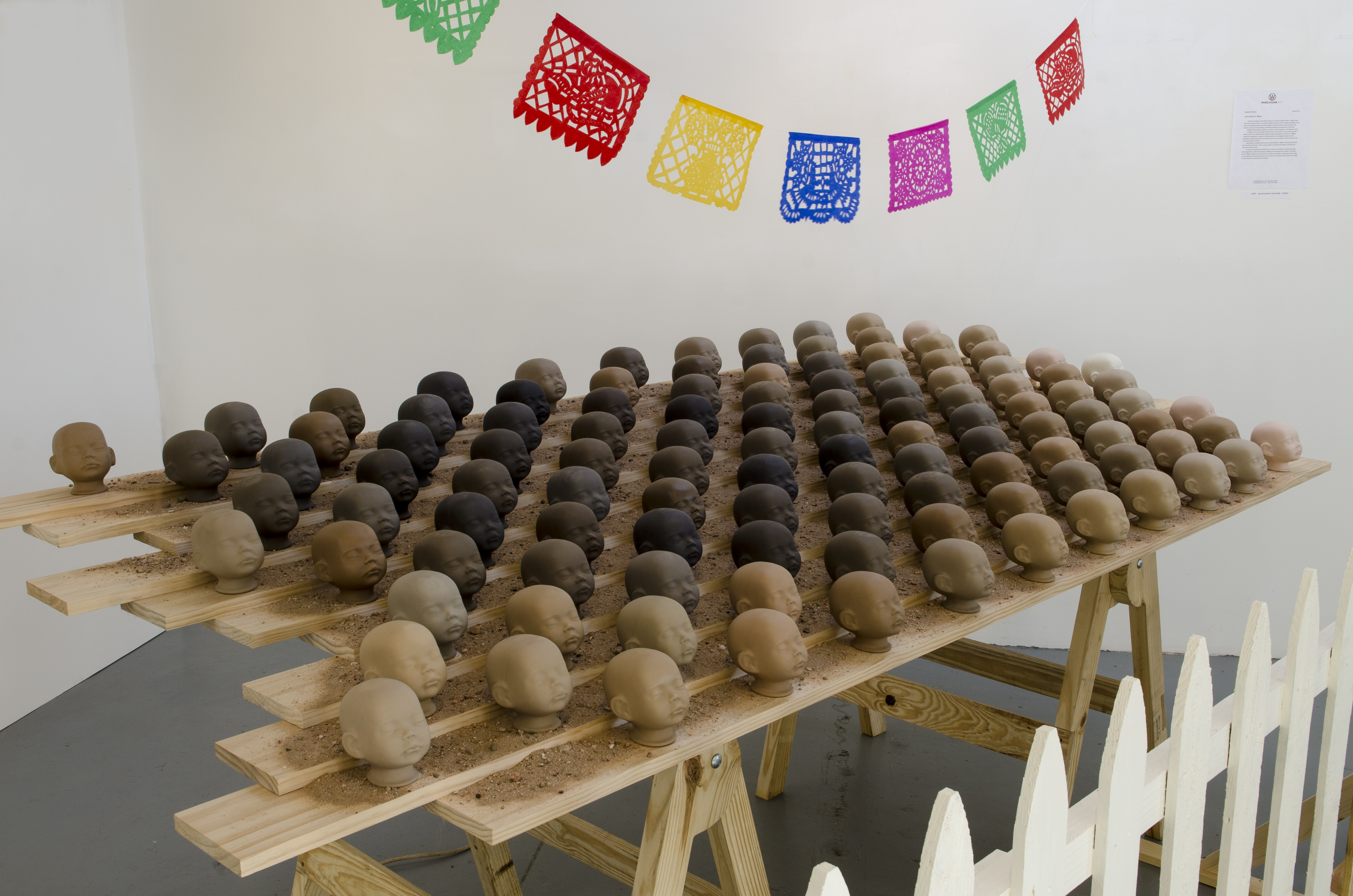
In ‘Wave’, dozens of porcelain doll heads form a human wave. The porcelain is tinted a variety of skin tones, representing the range of peoples attempting to enter the U.S. ‘Wave’ portrays the immigrants as a wave of human potential, as yet untapped, perhaps unborn, steadfastly moving forward. Here, even adults may be seen as infants, as those entering a new country are starting a new life.
Papel picado (cut paper) banners grace many festivities in Mexico. They have also found their way into the detention centers housing children in custody at the border, and here hang above the porcelain heads.
For many, the picket fence symbolizes cozy American domesticity. Ironically, the picket fence originated as a defensive structure, protecting the homestead from intrusion. The picket fence in ‘Wave’ beckons even as it blocks an unwelcome population. Half-painted, with an open can of whitewash, the fence evokes the mythic America of Tom Sawyer while hinting at the reality of limited opportunity awaiting many immigrants.
 ‘They Became What They Beheld’
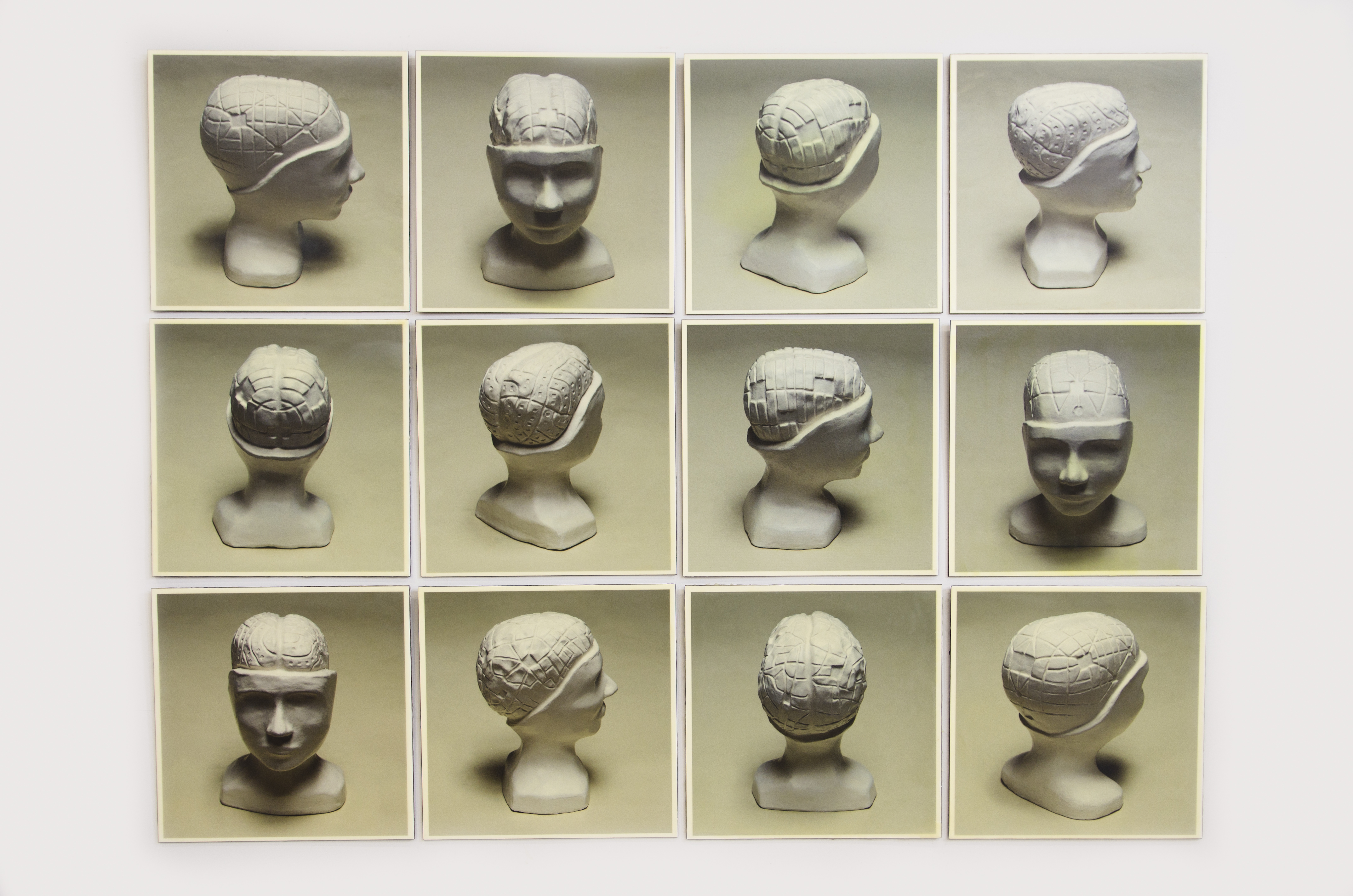
‘They Became What They Beheld’ explores the feedback loop between the built environment and human consciousness. In our culture, this relationship is seen as mostly a one-way street. Humans plan, design, and build cities, houses, and roads, shaping the environment to meet real and imagined needs. The resulting patterns and artifacts imprint the earth. In a more subtle way, they imprint us.
In ‘They Became What They Beheld’, I use the human brain to represent this phenomenon. The images comprising the piece are photographs of clay heads built with exposed brains, loosely based on archaic medical models. Here, the conventional convolutions of the brain are replaced with urban forms characteristic of various stages of Western history. For example, the Medieval brain embodies the meandering street patterns typical of that era, while the Suburban brain shows the distinctive, curving pattern of the contemporary suburb. The works explore the notion that our minds are impacted, even shaped, by the physical environment in which we develop.
The light found in some of the great old museums has a soft, sub-aqueous quality. In addition to lending a timeless character to the spaces, it particularly enhances white marble and plaster. With a white terra sigillata finish, the heads in ‘They Became What They Beheld’ are similar in surface to the old statues found in these museums. The encaustic photographs evoke that watery light, as well as referencing early photographic bookplates of art works, to create a historically ambiguous setting for this piece.
The title, ‘They Became What They Beheld’, refers to a work by Edmund Carpenter, an anthropologist who studied the impact of media and culture on human sensibility.
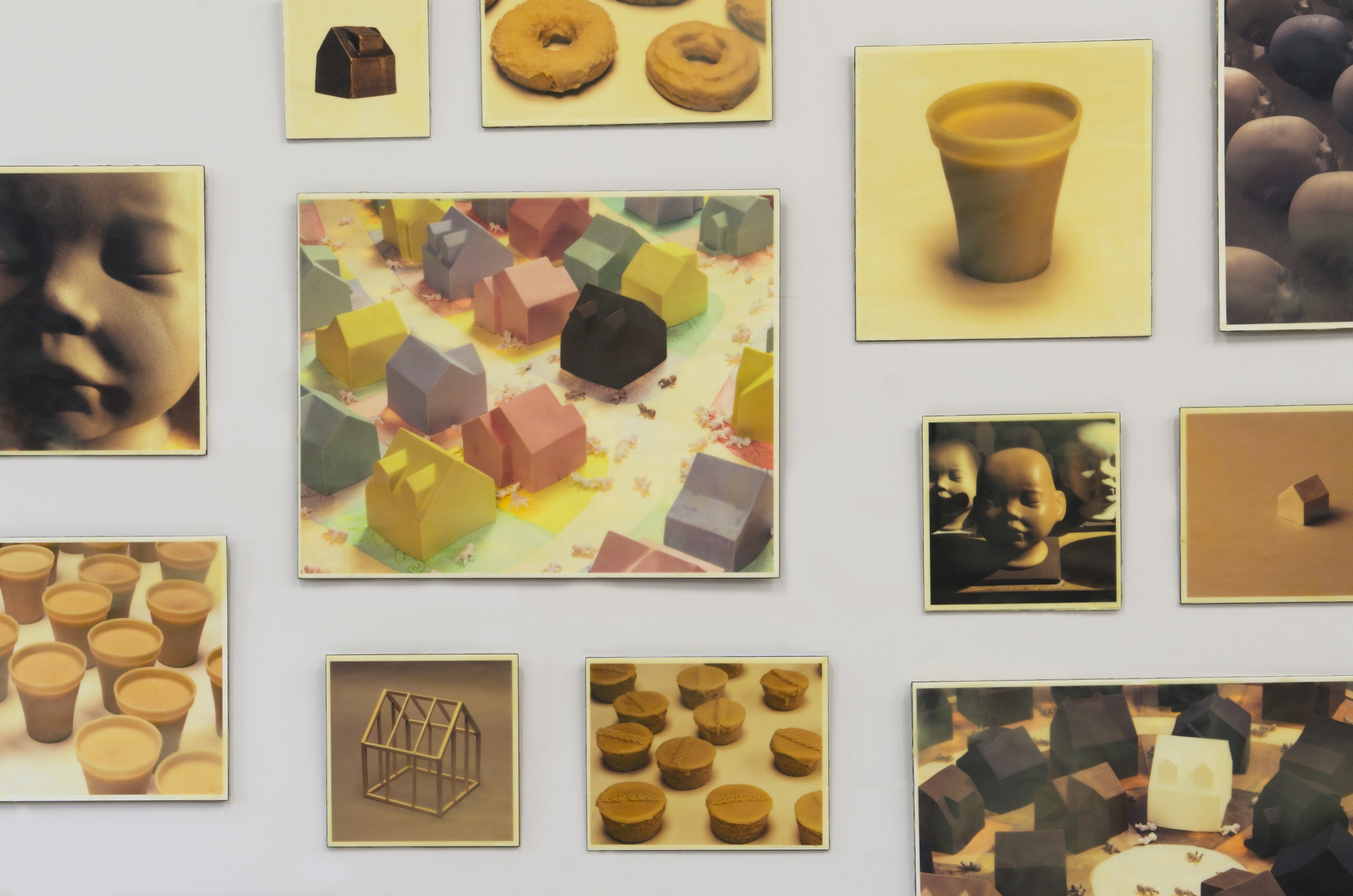 ‘Collective Unconscious: Addenda’
‘Collective Unconscious: Addenda’ is a work of constructed photography. The images in this piece have a familiar quality, bringing to mind the collages covering many of our refrigerator doors. This collage, however, has grown and exploded. It contains images dredged up from a modern collective unconscious rather than the details of an individual family’s life.
The images are strewn over the wall in an apparently haphazard manner, though on closer examination the arrangement has an inner logic. Photographic pictograms, they form a text legible to a transliterate, image-saturated society, possibly evoking memories you didn’t know you had. Are these images from the past or in the future? Do they represent a fond memory or a suppressed nightmare? (Even harsh realities can take on a warm glow through the honey-colored prism of nostalgia.)
The images themselves portray created scenarios, referencing aspects of contemporary life in abstracted form. Images of mass-produced housing, migrant populations, and economic distress are juxtaposed with iconic styrofoam cups, cupcakes and doughnuts. Cast in beeswax and porcelain, these ‘stand-ins’ have a soft, luminous quality at odds with the referents themselves.
A beeswax coating gives the images a golden glow and mild scent of honey. The beeswax slightly obscures and yellows the image, making it somewhat unavailable and hard to place in time and space. The white border references early ‘snapshot’ photography, in which ‘snapshot’ equals spontaneity as well as memory.
 Margaret Denney