
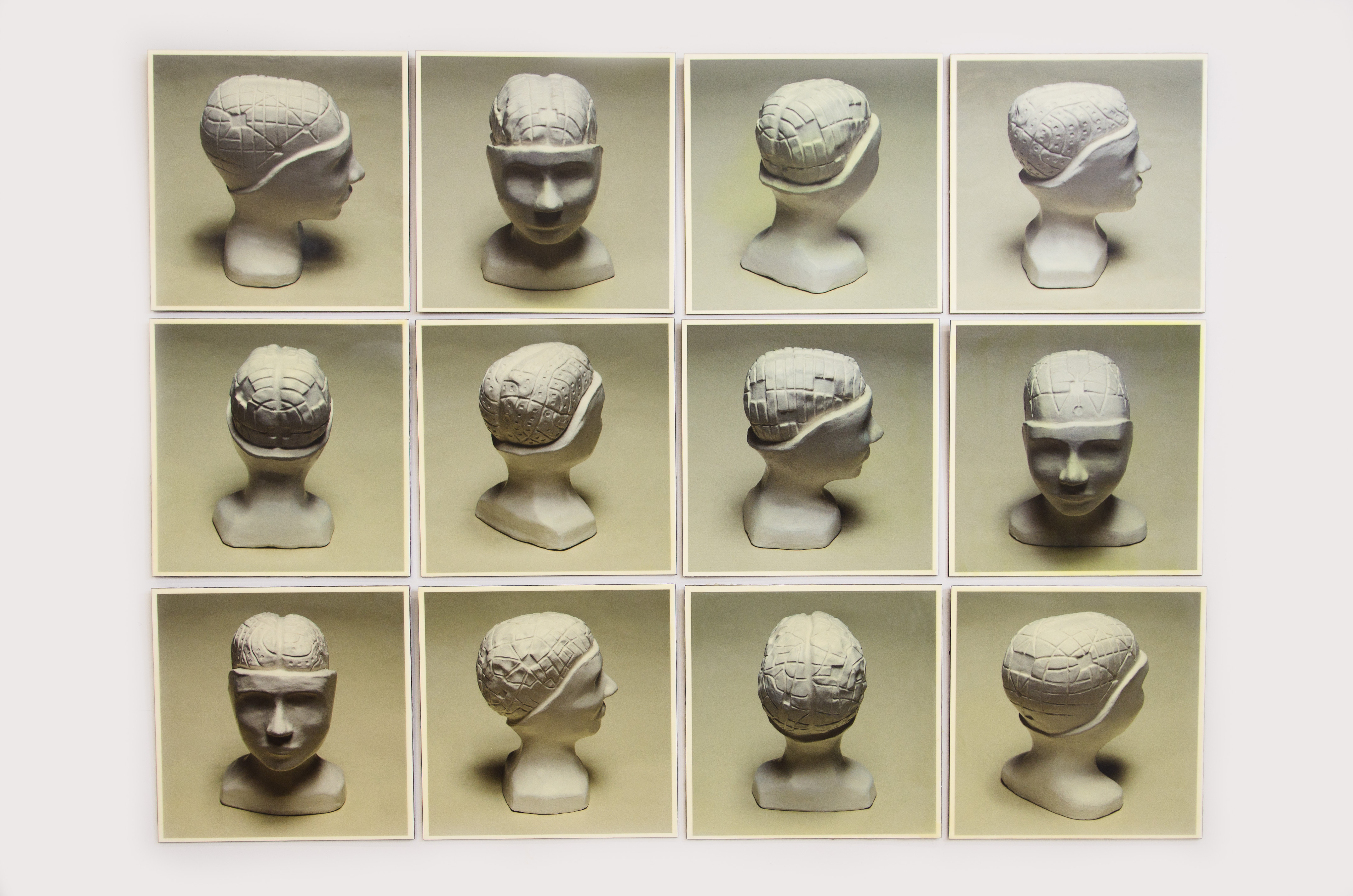
 ‘They Became What They Beheld’ explores the feedback loop between the built environment and human consciousness. In our culture, this relationship is seen as mostly a one-way street. Humans plan, design, and build cities, houses, and roads, shaping the environment to meet real and imagined needs. The resulting patterns and artifacts imprint the earth. In a more subtle way, they imprint us.
In ‘They Became What They Beheld’, I use the human brain to represent this phenomenon. The images comprising the piece are photographs of clay heads built with exposed brains, loosely based on archaic medical models. Here, the conventional convolutions of the brain are replaced with urban forms characteristic of various stages of Western history. For example, the Medieval brain embodies the meandering street patterns typical of that era, while the Suburban brain shows the distinctive, curving pattern of the contemporary suburb. The works explore the notion that our minds are impacted, even shaped, by the physical environment in which we develop.
The light found in some of the great old museums has a soft, sub-aqueous quality. In addition to lending a timeless character to the spaces, it particularly enhances white marble and plaster. With a white terra sigillata finish, the heads in ‘They Became What They Beheld’ are similar in surface to the old statues found in these museums. The encaustic photographs evoke that watery light, as well as referencing early photographic bookplates of art works, to create a historically ambiguous setting for this piece.
The title, ‘They Became What They Beheld’, refers to a work by Edmund Carpenter, an anthropologist who studied the impact of media and culture on human sensibility.
Medium: Encaustic Photographs on Panels Dimensions: 48″ x 64″ Date: 2014


 Margaret Denney